Analysis No. 04 · Evidence
I found a trigger food. It was fake.
After 179 days of logging every meal, one food category came back with a strong, statistically significant effect on my reflux. It passed the strictest correction I know how to apply. It was still wrong, and the way it was wrong is the reason most people never find their triggers.
01 — Where the trigger list came from
Every list of reflux trigger foods carries the same items. Chocolate, coffee, citrus, tomato, fat, spice, mint, alcohol. I've read that list on a hospital handout and on the back of an antacid box, and I'd guess you have too.
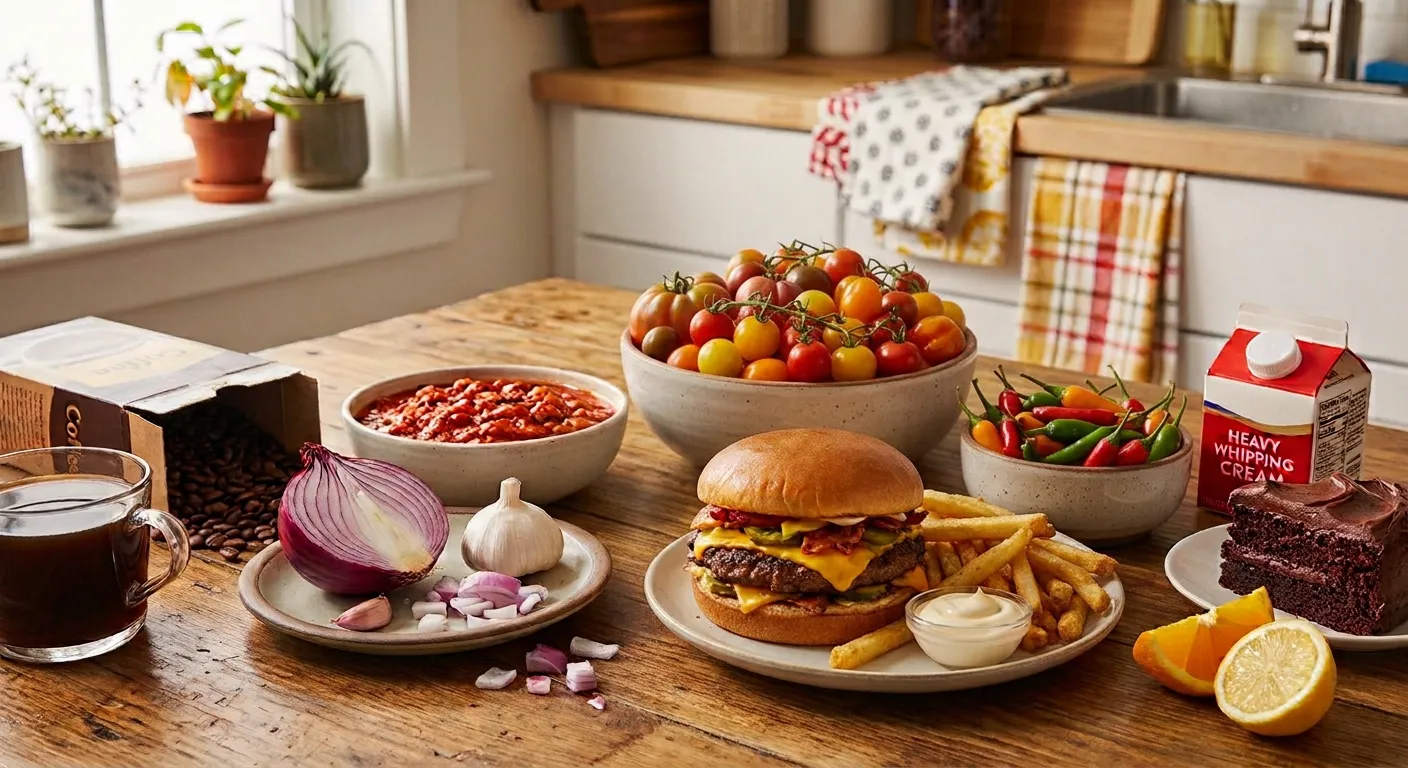
It has a real origin. Researchers put pressure catheters into people and measured what happened to the lower esophageal sphincter, the valve between the stomach and the esophagus, after they ate. Fat, chocolate and alcohol lowered its resting pressure. Those measurements hold up.
The trouble is which question they answer. They answer can this food relax the valve? The question a person with reflux is asking is if I stop eating it, will I feel better? Those come apart more easily than you'd expect.
In 2006 a Stanford group went looking for the second answer. They screened more than 2,000 GERD studies published between 1975 and 2004. Sixteen had tested whether making a lifestyle change improved symptoms. For dietary restriction, chocolate and coffee and citrus and spicy food and fried food and carbonated drinks and alcohol, they found no evidence it worked.1 Two measures survived their review: losing weight, and raising the head of the bed.
"There is currently no evidence to show that any of the dietary restrictions usually recommended make a difference," the lead author said at the time.2
Sixteen years later the American College of Gastroenterology still suggests avoiding trigger foods, and still rates the quality of the evidence behind that suggestion as low.3
| Food | Why it's on the list | Evidence that removing it helps |
|---|---|---|
| Chocolate | Relaxes the valve, measured directly | None found |
| Fried & fatty food | Relaxes the valve, slows stomach emptying | None found |
| Coffee | Relaxes the valve | None found |
| Citrus | Irritates an already inflamed esophagus | None found |
| Spicy food | Widely reported by patients | None found |
| Carbonated drinks | Distends the stomach | None found |
| Alcohol | Relaxes the valve | None found |
| Tomato | Acidic | Inverse — likely avoidance |
| Sugar-sweetened drinks | Rarely on the list at all | Tracked measured acid |
"Relaxes the valve" from the pressure studies summarised by Kaltenbach et al.1 The removal column is that same review. The two bottom rows are the only foods that showed any association at all in 98 patients on 24-hour pH probes.7
02 — So I tested it on myself
179 days. 564 meals, each one's ingredients tagged into 20 categories. Every day marked for whether reflux showed up. I ran each food category against the same day, then against the next day, then the day after that, in case something was arriving late.
Almost everything came back flat. Fat, tomato, spice, fried food, dairy, processed meat, all of it: nothing worth reporting.
Except sweets, which is a category I had every reason to take seriously. Chocolate sits on every trigger list ever printed, and sugar-sweetened drinks (tea, soda and juice) were the one thing in that pH-probe study that clearly tracked higher measured acid exposure.7 So when the number came back, it looked like the one piece of conventional advice my data was going to confirm.
On days I ate something sweet, I had reflux 33% of the time. On days I didn't, 59%. These are two separate groups measured separately, so they don't add up to 100%: of my 104 dessert days, a third had reflux; of my 75 non-dessert days, nearly six in ten did.
179 days, 23 Jan – 20 Jul 2026. Odds ratio 0.34, 95% CI [0.19, 0.63], p = 0.0006.
Dessert looked like it was cutting my bad days almost in half. This wasn't a shaky result either. It survived the strictest correction I know how to apply, the one built specifically to catch flukes when you've run a lot of tests at once.
I believed it for about a day.
03 — Then I looked at when I eat dessert
The first analysis I published on this site found that two things predicted a bad day for me, and neither was food: stress and how sedentary I'd been. So I took the same four day-types from that analysis and measured something else against them.
Same 179 days, sorted by self-rated daily position. Both lines measure the same thing, the share of days in that group, so they share one axis.
On the days I sat from morning to night, I had something sweet 44% of the time. On days I was up and moving, 95%. Sorted by stress instead, the split is starker: on my calmest days, 71%; on my most stressed days, 10%.
The reason isn't mysterious, and it has nothing to do with my stomach. On an active day I'm climbing or walking for hours, and I want the energy back afterwards, so I eat something sweet. On a day at the desk I've burned very little and the craving never arrives. My sugar intake is downstream of how much I moved.
Which means the reflux and the dessert were being dragged around by the same thing. When I put stress and sedentary time into the model alongside sweets, the sweets effect fell by half and stopped being significant (odds ratio 0.34 to 0.60, p = 0.14). The day had been doing the work the whole time. Statisticians call a hidden third variable like this a confounder, and it's the same shape of error that made vitamin supplements look protective for decades until randomised trials found nothing. People who took vitamins also slept and ate and exercised differently.
Sweets are a consequence of my activity, and my activity is what moves my reflux. The dessert was never acting on anything.
04 — Fifty-one questions
There's a second, more ordinary problem sitting underneath all of this. I didn't ask my data one question. I asked it 51: seventeen food categories with enough days to test, each checked against the same day, the next day, and two days later.
Five came back positive.
17 food categories × 3 lags. Fisher's exact test on each; five at p < 0.05, one surviving Bonferroni correction.
If every one of those foods were entirely irrelevant to my reflux, chance alone would have handed me about two or three positives anyway. I got five. Chocolate turned up twice, grain once, nuts once, and I have no reason to believe any of them mean a thing.4
That problem has a standard fix, and I applied it. Four of the five disappeared.
Sweets survived. The arithmetic was right, the test was honest, the correction was applied, and the conclusion was still wrong. No amount of statistical hygiene tells you that the dessert is downstream of how far I walked that day. Only knowing my own routine does that.
05 — Now try it without the data
Everything above took 179 days of logging and a regression to see. Someone working it out in their head has worse tools and more working against them.
Attention. You remember the curry that was followed by heartburn. You don't remember the four curries that weren't, or the heartburn on the day you ate nothing but rice.
Expectation. When people who were confident they were gluten-sensitive got tested blind, 16% reacted to gluten. 40% reacted to the placebo.5 More of them were made ill by the idea of the food than by the food.
Starting point. Nobody begins an elimination diet during a good month. You start during your worst one, and bad months are followed by better months. That's what "worst" means. Whatever you started gets the credit.
06 — Does food matter at all, then?
Yes, and I'd be overreaching to argue otherwise. One study found elimination works: Italian GPs had patients name the foods that seemed to set them off, cut those foods, and return in two weeks. GERD scores improved 23%, and 45% of patients came off their medication.6 That's a real result. But there was no control group, no blinding, and a two-week window, so it can't separate "the diet worked" from the four things in the last section.
Better evidence comes from studies that measure instead of asking. When 98 patients wore 24-hour pH probes, most of the classic trigger list did nothing. What tracked with measured acid exposure was the type of fat, saturated against unsaturated, and sugar-sweetened drinks. The authors noted that despite decades of advice to avoid particular foods, almost none of those foods showed up in their data.7
That study also contains a small version of my own mistake. Tomatoes came out looking protective, and the authors say plainly why: the patients with the worst reflux were the ones already avoiding tomatoes. The food was tracking the diagnosis, not driving it. Even with pH probes and a funded study, the direction of the arrow is the hard part.
And there's a solid reason not to wave away personal data. Eight hundred people wearing continuous glucose monitors through nearly 47,000 meals responded to identical food in different directions, which led the authors to question whether universal dietary advice is much use at all.8 Your response to a food may genuinely differ from mine. Individual variation is real. It's seeing it from the inside that's hard.
07 — What would actually settle it
The ACG guideline says how to do this properly, and hardly anyone does it: elimination followed by rechallenge. Cut the food, see whether things improve, then deliberately put it back and see whether they return.3 The rechallenge is the step that gets skipped, and it's the only step that tests anything.
One person can run this rigorously. There's a published n-of-1 trial in reflux where a single patient completed 12 randomised, double-blind pairs of treatment periods across 24 weeks, with washouts in between, at 96% adherence. It found that doubling his medication did nothing for him, against what the group-level evidence predicted.9
A food association can be real, significant, and correctly calculated, and still be measuring your week rather than your meal.
What I'm doing next is narrower than what I did here. One candidate, picked in advance. The rule for what counts as a symptom written down before I start. Which days it's on decided by a coin rather than by my mood. And one thing tested instead of 51.
Frequently asked
- Why can't I identify my acid reflux trigger foods?
- Because several things work against you at once. You remember the meals that were followed by symptoms and forget the ones that weren't. Most people start an elimination diet during a bad stretch, which is the stretch most likely to improve on its own anyway. And foods travel together with everything else about a day, so a food can look like a trigger when it is really standing in for your stress, your sleep or how much you moved. In my own 179 days of tracking, the one food that looked like a strong trigger turned out to be a consequence of how active I'd been that day, not a cause of anything.
- Do trigger foods actually cause acid reflux?
- Some foods measurably relax the valve at the top of the stomach — fat, chocolate and alcohol were shown to do this decades ago. But that's a different question from whether removing them helps. A Stanford review screened over 2,000 GERD studies and found no evidence that dietary restriction improved symptoms. The 2022 American College of Gastroenterology guideline still suggests avoiding trigger foods, and rates its own confidence in that advice as low.
- How long after eating does acid reflux start?
- In my data, the median gap between a meal and a symptom was about 90 minutes, with most falling between one and two hours. That's across 91 symptom episodes in one person, not a rule. Whether that lets you pin a symptom on a particular meal depends on how you eat: my meals are about four and a half hours apart, so only about one episode in ten landed after the following meal. If you graze or snack between meals, the windows overlap and attribution gets much harder.
- Does eliminating foods help GERD?
- The evidence is thin and mixed. One primary-care study found that cutting patient-identified trigger foods improved GERD scores by 23% and let 45% stop their medication, but it had no control group, no blinding, and a two-week follow-up. The guideline-recommended approach is elimination followed by rechallenge: remove the food, then deliberately put it back to see whether symptoms return. The rechallenge is the step that actually tests anything, and it's the step most people skip.
- Is a food diary useful for reflux?
- Useful, but harder to read than it looks. Mine surfaced a strong, statistically significant association between sweets and fewer symptoms that turned out to be an artifact of when I eat dessert. A diary is good at recording what happened and bad at telling you why. It's a starting point for a deliberate test, not a substitute for one.
References
- Kaltenbach T, Crockett S, Gerson LB. Are lifestyle measures effective in patients with gastroesophageal reflux disease? An evidence-based approach. Arch Intern Med. 2006;166(9):965–971.
- Stanford Medicine. Chocolate, wine, spicy foods may be OK for heartburn, Stanford study finds. 2006.
- Katz PO, Dunbar KB, Schnoll-Sussman FH, Greer KB, Yadlapati R, Spechler SJ. ACG Clinical Guideline: Guidelines for the Diagnosis and Management of Gastroesophageal Reflux Disease. Am J Gastroenterol. 2022;117(1):27–56.
- Gelman A, Loken E. The garden of forking paths: why multiple comparisons can be a problem, even when there is no “fishing expedition”. Columbia University. 2013.
- Molina-Infante J, Carroccio A. Suspected nonceliac gluten sensitivity confirmed in few patients after gluten challenge in double-blind, placebo-controlled trials. Clin Gastroenterol Hepatol. 2017;15(3):339–348.
- Tosetti C, Savarino E, Benedetto E, De Bastiani R. Elimination of dietary triggers is successful in treating symptoms of gastroesophageal reflux disease. Dig Dis Sci. 2021;66:1565–1571.
- Gu C, Olszewski T, Vaezi MF, Niswender KD, Silver HJ. Objective ambulatory pH monitoring and subjective symptom assessment of gastroesophageal reflux disease show type of carbohydrate and type of fat matter. Therap Adv Gastroenterol. 2022;15:17562848221101289.
- Zeevi D, Korem T, Zmora N, et al. Personalized nutrition by prediction of glycemic responses. Cell. 2015;163(5):1079–1094.
- Sierra-Arango F, Castaño DM, Forero JD, et al. A randomized placebo-controlled n-of-1 trial: the effect of proton pump inhibitor in the management of gastroesophageal reflux disease. Can J Gastroenterol Hepatol. 2019;2019:3926051.
None of this is medical advice, and one person's data can't be yours. But the tracking is transferable: log a few weeks and I'll run this same analysis on it.
Get the free tracking template