Analysis No. 05 · Evidence
My reflux ignores the night shift
I sleep on an inclined bed, on one side, and I have done for over a year. I get eight hours. By the standards of almost every reflux guide on the internet, I have already done the work. So I plotted when my symptoms actually happen, and found that three of ninety-five episodes were at night.
01 — The advice I had already taken
Search for reflux advice and you will be told about your bed. Raise the head of it. Sleep on your left. Stop eating three hours before you lie down. Buy the wedge pillow. The recommendations are everywhere, they are in the guidelines, and the trials behind them are real: a randomised study of a sleep positioning device cut measured acid exposure,6 a systematic review of head-of-bed elevation found consistent symptom benefit,7 and monitoring sleep position alongside esophageal pH showed right-side sleeping produced more reflux than left.8
I run all of it. The bed has been inclined for more than a year, which means it covers every one of the 179 days in this dataset. I sleep on one side. My median night is eight hours and 94% of my nights are seven or more. There is no compliance problem here to explain away a poor result, and the daily logging protocol has not changed over that period either.
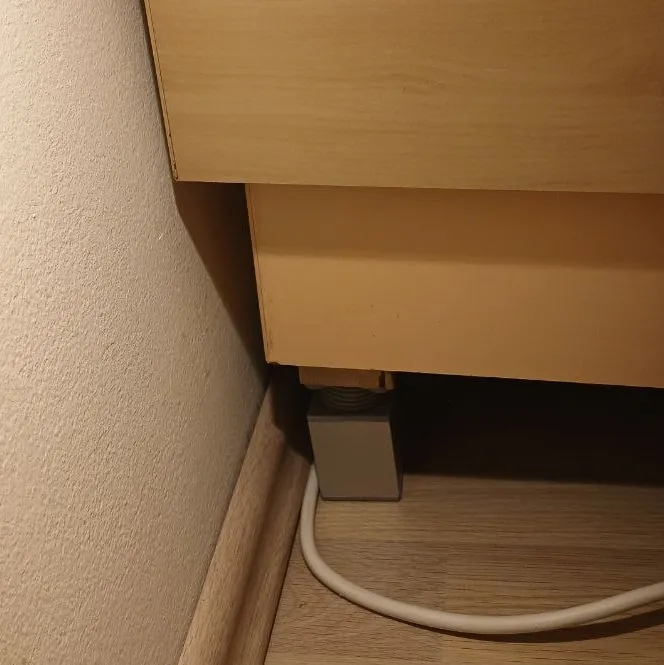
Not a wedge pillow. The whole frame is tilted, which is the version the trials tend to test.
The only change I noticed after raising the bed was more mornings with a stiff neck. That is a subjective impression from before I started logging anything, so treat it as an anecdote rather than a finding. It is the only effect I can report.
02 — When my symptoms actually happen
Every symptom event in my log carries a timestamp, and I had never once looked at the distribution. Here are all 95 of them, by hour.
Shaded band is my typical sleep window. Median bedtime 22:30, median wake 07:00.
Three events between 22:00 and 06:00, out of 95. One of those was at 05:00, close enough to waking that I may have simply been awake to notice it. The rest of the night is empty.
The daytime is not empty at all. The largest single hour is 15:00 with 16 events, and there are smaller rises at 10:00 and 20:00. Line those up against my median meal times of 08:00, 13:00 and 18:00 and each bump sits roughly two hours after a meal.
83% of my symptom events began within three hours of a meal, with a median gap of 1.5 hours. My reflux tracks meals, and I eat sitting up.
03 — This is the more common pattern
I assumed I was unusual. I am not, or at least not obviously so. Split patients by when acid actually reaches the esophagus and you get recognised groups rather than one disease. In a series of 79 patients with laryngopharyngeal reflux and confirmed acid events, 62% refluxed while upright, 25% while supine, and 13% did both.10 I should be careful with that number, because those were throat-symptom patients measured at the pharynx, and the split shifts with the population and the probe. What survives across studies is the classification itself. Upright reflux is a common pattern in its own right.
The two groups also look different underneath. Upright reflux is associated with post-meal mechanisms and delayed gastric emptying, while supine reflux tracks more closely with low resting pressure in the lower esophageal sphincter and with poor acid clearance once you are lying flat.1,2 Supine refluxers also carry a higher rate of esophagitis, which is part of why night-time reflux gets the clinical attention it does.
So the advice stack is aimed at the group with the worse complications, not the larger group. That is defensible medicine and terrible search results, because the person typing "why do I get heartburn after lunch" lands in a page about pillows.
04 — What a 1.5 hour delay points at
A median gap of 1.5 hours between meal and symptom is a specific enough number to check against a mechanism. The one that fits is the acid pocket. After a meal, food buffers most of the acid in the stomach, but a layer of unbuffered, highly acidic juice sits on top of the meal right at the junction with the esophagus.3 It is the most likely thing to come back up in the hours after eating.
Where that pocket sits matters more than whether it exists. When researchers imaged its position directly, an acid pocket sitting above the diaphragm meant 70–85% of transient sphincter relaxations were accompanied by acidic reflux, against 7–20% when the pocket stayed below.4 That is a mechanism which operates while you are upright and digesting, and it has nothing to do with your pillow.
Schematic, not to scale. Percentages are the share of transient sphincter relaxations that produced acidic reflux in Beaumont et al.4
This is also why I stopped expecting the answer to be an ingredient. A mechanism that depends on when you ate and what position you are in will not show up as a guilty food, which is roughly what my first analysis found when eighteen food categories produced nothing that survived correction, and what the fourth found again when the one convincing food effect turned out to be confounded.
It also explains why my post-meal window is the risky one rather than my night. By bedtime, a median five hours after my last meal, the pocket has had time to empty.
05 — Testing the bedtime rule on my own log
If my reflux really is post-meal rather than positional, then the most famous timing rule in reflux should do nothing for me. The guidelines advise against eating within two to three hours of bed,5 and the study behind that advice found a real association between a short dinner-to-bed gap and reflux disease.9
I have the gap for all 179 days. Median 5 hours, range 1 to 10. Fed into a logistic model alongside the two predictors I already know matter, it produced an odds ratio of 1.003 with p = 0.975, which is about as close to nothing as a coefficient gets. The two predictors I already trust held their ground in the same model:stress at an odds ratio of 1.89 and sedentary time at 1.96.
The meal-level view says the same thing more bluntly.
Meal counts under each bar. The 19:00–24:00 block is the smallest and the quietest.
My late meals were the safest meals I ate: 6.1% of them were followed by a symptom, against 24.0% for meals eaten between 10:00 and 13:00. Days I flagged as late-eating days had a lower symptom rate than the rest, 38.8% against 45.4%.
This is not evidence that the three-hour rule is wrong. It is evidence that it does not describe me. I only have 25 days with a gap under three hours and four under two, and at that exposure I could only have detected the symptom rate jumping to about 75%. A real effect of the size reported in the literature would need roughly 78 short-gap days before I could see it. The rule and my log are not in conflict; my log cannot see the rule.
06 — What I cannot see
The obvious objection to Figure 2 is that I am asleep for the empty part of it. Silent nocturnal reflux exists, it does not wake you, and my method has no way to catch it. A pH probe would settle this and a diary never will. If you take one caveat from this post, take that one.
Two things stop me from dismissing the whole chart, though. The first is that my evening meals, eaten and digested during hours I was awake and logging, were the least likely of any block to be followed by a symptom. That result does not depend on being conscious at 3am. The second is that my nights are the intervention arm: inclined bed, side sleeping, eight hours, for the entire dataset.
Which cuts both ways, and I should say so plainly. My night may be quiet because my phenotype is diurnal, or because the wedge is working. I have no pre-inclination baseline in this data, so I cannot separate those two explanations, and I am not going to sleep flat for three months to find out.
07 — What this changes
For me, the sleep-side levers are pulled. There is nothing left to optimise there, and further reading about pillow angles is not going to produce anything. The window that matters is the two to three hours after I eat, which is where 83% of my symptoms live and where I have never directed a single intervention.
That suggests things I can actually test: staying upright and moving after lunch rather than sitting back down at a desk, which connects directly to what sedentary days did to my symptom rate, and splitting lunch into a smaller meal, since the 10:00–13:00 block is my worst by a wide margin. Both go in the next round, alongside everything else I have written up so far.
Before you optimise your bed, check whether your symptoms are happening in it. Mine were not, and I had never looked.
The column that answered this had been sitting in the sheet since January. If you are tracking, plot your events by hour before you change anything else.
Frequently asked
- Why do I get acid reflux during the day but not at night?
- Reflux is classified by body position, and upright reflux is a common pattern in its own right. In one series of 79 patients with confirmed acid events, 62% refluxed while upright, 25% while supine and 13% did both, though that was a laryngopharyngeal-reflux group and the exact split varies with the population studied. Upright reflux is associated with post-meal mechanisms and delayed gastric emptying rather than with a weak valve at night, so someone with that pattern can have a nearly empty night and still have plenty of symptoms after meals.
- How long after eating does acid reflux start?
- In my own log of 95 symptom events, the median gap between a meal and the start of a symptom was 1.5 hours, and 83% of events began within 3 hours of a meal. That fits the post-meal acid pocket, a layer of unbuffered acid that sits at the top of the stomach after eating and is the most likely thing to reflux during that window.
- Does raising the head of the bed help acid reflux?
- Trials of head-of-bed elevation and of left-side sleeping do show reduced nocturnal acid exposure, so the advice has real support for people with night-time symptoms. It cannot help with symptoms that happen while you are upright and awake. I have slept on an inclined bed on one side for over a year, which covers every day in this dataset, and 3 of my 95 events fall between 22:00 and 06:00.
- Should I stop eating three hours before bed?
- The guideline recommendation exists and is reasonable, but in my data the gap between my last meal and bedtime had no measurable relationship to whether I had symptoms: odds ratio 1.003, p = 0.975 after adjusting for stress and sedentary time. Meals eaten after 19:00 were the least likely of any time block to be followed by a symptom. That is one person with a mostly daytime pattern, so it is evidence about my phenotype rather than about the rule.
References
- Dickman R, Parthasarathy S, et al. Pathophysiology of upright vs. supine gastroesophageal reflux. Am J Gastroenterol. 2008;103(S1):S21.
- Ouatu-Lascar R, Fitzgerald RC, Triadafilopoulos G. Upright versus supine reflux in gastroesophageal reflux disease. J Gastroenterol Hepatol. 2001;16(11):1184–1190.
- Fletcher J, Wirz A, Young J, Vallance R, McColl KEL. Unbuffered highly acidic gastric juice exists at the gastroesophageal junction after a meal. Gastroenterology. 2001;121(4):775–783.
- Beaumont H, Bennink RJ, de Jong J, Boeckxstaens GE. The position of the acid pocket as a major risk factor for acidic reflux in healthy subjects and patients with GORD. Gut. 2010;59(4):441–451.
- Katz PO, Dunbar KB, Schnoll-Sussman FH, Greer KB, Yadlapati R, Spechler SJ. ACG clinical guideline for the diagnosis and management of gastroesophageal reflux disease. Am J Gastroenterol. 2022;117(1):27–56.
- Person E, Rife C, Freeman J, Clark A, Castell DO. A novel sleep positioning device reduces gastroesophageal reflux: a randomized controlled trial. J Clin Gastroenterol. 2015;49(8):655–659.
- Albarqouni L, Moynihan R, Clark J, Scott AM, Duggan A, Del Mar C. Head of bed elevation to relieve gastroesophageal reflux symptoms: a systematic review. BMC Fam Pract. 2021;22(1):24.
- Schuitenmaker JM, van Dijk M, Oude Nijhuis RAB, Smout AJPM, Bredenoord AJ. Associations between sleep position and nocturnal gastroesophageal reflux: a study using concurrent monitoring of sleep position and esophageal pH and impedance. Am J Gastroenterol. 2022;117(2):346–351.
- Fujiwara Y, Machida A, Watanabe Y, et al. Association between dinner-to-bed time and gastro-esophageal reflux disease. Am J Gastroenterol. 2005;100(12):2633–2636.
- Wang AM, Wang G, Huang N, et al. Characteristics of upright versus supine reflux pattern in patients with laryngopharyngeal reflux. Auris Nasus Larynx. 2019;46(3):373–378.
None of this is medical advice, and one person's data can't be yours. But the tracking is transferable: log a few weeks and I'll run this same analysis on it.
Get the free tracking template